Troubleshooting a High Bacteria Count in Milk
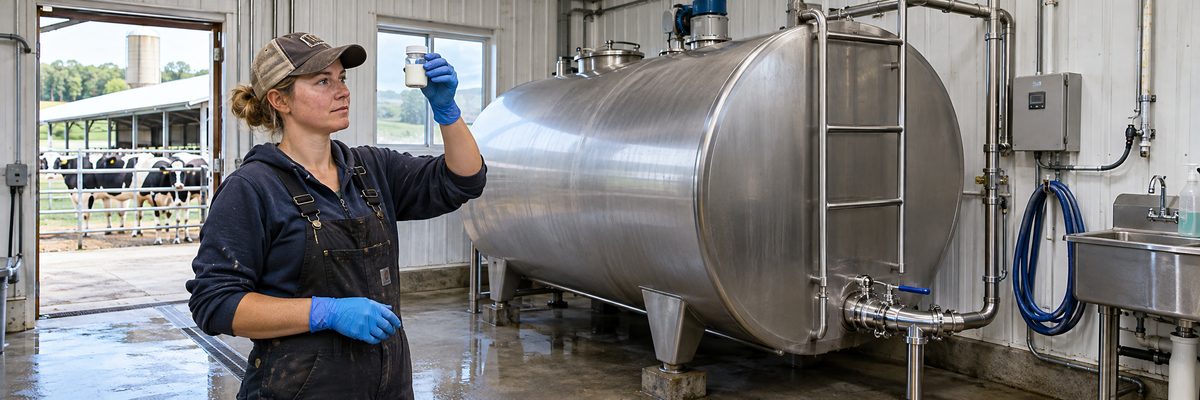
The notice came in the mail, or the milk truck driver handed it over with a look. Your bacteria count is high. Before anyone starts replacing parts, work through a short list: udder prep and cow cleanliness, the washing routine, worn rubber, cooling, water, and mastitis. One of them is nearly always the source, and the lab results can tell you which.
Under the model Grade A rules, as summarized by UW-Madison Extension, individual producer milk should not exceed 100,000 bacteria per milliliter, and a Grade A permit can be suspended if three of five consecutive samples go over that line. Your state and buyer may be stricter, and many buyers pay premiums for counts far below the legal limit.
The good news: a high count is a puzzle with a limited number of pieces. The bad news is that the lab report does not say "it's the liners."
Start by reading the numbers together
One count tells you little. Several together tell you a lot. Penn State Extension's piece on using bacterial counts as a tool for troubleshooting shows how to compare them. The main ones:
- Standard plate count (SPC): the overall bacteria number.
- Preliminary incubation (PI) count: a sample held cold for a while first, which favors cold-tolerant bacteria and points toward cleaning and cooling. More in what a high PI count says about your cleaning.
- Laboratory pasteurized count (LPC): bacteria that survive a heating step, often tied to equipment condition and cleaning.
- Coliform count: an indicator of manure or environmental contamination. The usual coliform sources and fixes are worth a look if this one is up.
- Somatic cell count (SCC): a window into udder health.
What the combinations suggest
| What is high | Look first at |
|---|---|
| SPC and coliform, with high SCC | Coliform mastitis or a bedding and cow cleanliness problem |
| PI and SPC, coliform normal | Wash routine, equipment condition, cooling |
| LPC up, coliform not | Equipment sanitation and condition |
| LPC and coliform up together | Milking procedures and equipment both |
| Coliform alone | Dirty udders, wet bedding, contaminated water |
These are leads, not verdicts. Think of them as pointing the flashlight at the right corner of the barn.
The checklist
1. Cow and udder cleanliness
Dirty cows have dirty teats, and dirty teats put manure and bedding bacteria into the unit. Look at the cows as they come into the parlor. Check bedding in stalls, mud in lots and alleys, and how pre-milking teat prep actually gets done on a busy morning, not how it is written on the wall. Teat dip needs enough coverage and contact time to work.
2. Wash routine
Check every step: rinse, detergent, acid, sanitize. Measure start and end temperatures, check chemical mixes and confirm the air injector and the water heater are working. The sequence itself is laid out in the pipeline wash cycle basics.
3. Equipment condition
Cracked or worn liners, loose gaskets, scored tubing and pitted surfaces hold bacteria where a wash cannot reach. Rubber has a service life, and a liner change schedule that is actually followed is cheaper than a rejected load. Also look for dead ends, low spots where water pools, and cracked milk hoses.
4. Cooling
Time the pull-down on a hot day. The standard is 45°F or colder within two hours after milking ends. If the tank is slow, bacteria get more time to multiply; the section on bulk tank cooling requirements has the details.
5. Water supply
Test the wash water for coliforms. Penn State points out that a contaminated water supply can show up as higher coliform counts, while hard water that weakens detergents can raise PI counts instead.
6. Mastitis
A cow with an udder infection can shed large numbers of bacteria into the milk. If SCC is up along with the bacteria count, check for clinical and subclinical cases. Your vet can guide testing and treatment, and any treated cow's milk must be held out for the full withdrawal period.
A practical way to run the investigation
- Pull the last several lab reports and line up the counts by date. Look for the day things changed.
- Ask what else changed that week: a new milker, new bedding, a different detergent, a new liner set, a heat wave, a repaired heater.
- Walk the whole system with the wash sheet in hand, from pre-rinse through the bulk tank, and check each item with your own eyes.
- Have your milk plant fieldman or equipment dealer look at the system. They have seen the same problem on other farms and can spot things you walk past daily.
- Change one thing at a time, and give it a few lab cycles before you decide whether it worked.
The reason for changing one thing at a time is dull but real. If you replace the liners, switch detergent and drain the tank in the same week and the count drops, you have fixed the problem and learned nothing.
Regional wrinkles
Hot, humid summers in the Southeast often push counts up because cooling and cow cleanliness both suffer, as is common with summer bacteria counts in the Southeast. Wet spring mud in the Northeast does the same through dirty udders. Dust in dry-lot dairies out West gets into everything, including condensers and wash sinks, and hard water in the Mountain West complicates detergent choice.
Whatever your region, the best insurance is a written routine and someone who checks it. A farm with a solid wash sheet and a calibrated thermometer is a farm that can solve a bad count in a week and not in a season.
Quick answers
What is a normal bacteria count for milk?
Under the model Grade A standard, individual producer milk should not exceed 100,000 per milliliter, and many herds run far lower. Buyers' quality programs often reward counts well under the legal limit.
What is the most common cause of a high bacteria count?
Extension sources point most often to cow and udder cleanliness, equipment cleaning problems, and slow cooling. Mastitis can also contribute, so check SCC alongside the bacteria numbers.
How long until my count comes down after I fix something?
It depends on how often your plant tests, which can range from weekly to every pickup. Give it a few test cycles and keep tracking before deciding whether the fix worked.