How Fast Must Milk Cool in the Bulk Tank?
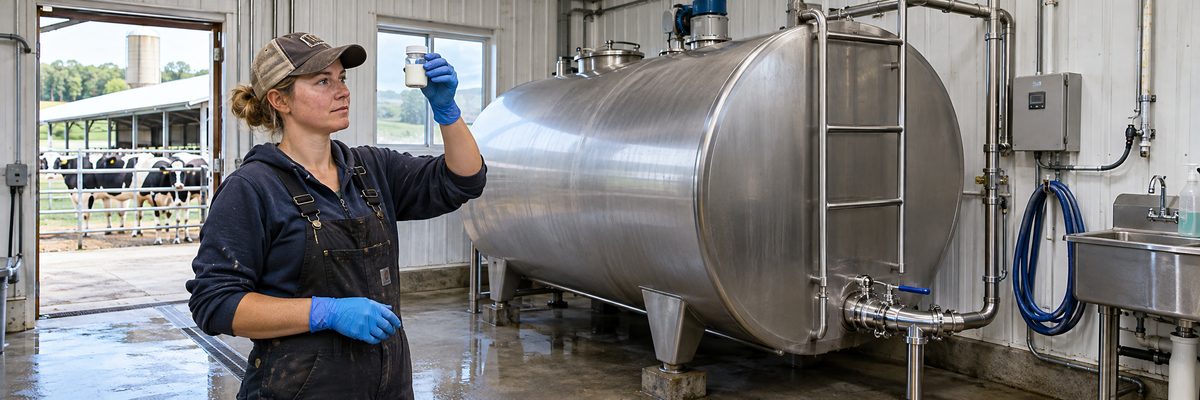
The short version of the Grade A rule: milk has to be at 45°F or colder within two hours after you finish milking. The Pasteurized Milk Ordinance, which most state dairy programs build on, also lets the first milking into an empty tank sit no warmer than 50°F within four hours, and it caps the blended temperature at 50°F when the next milking goes in on top of it.
That sounds simple until you try to make it happen in July with a tank that was sized for the herd you had ten years ago. A tank that "gets there eventually" is a different animal from a tank that gets there on time, and your hauler's thermometer does not grade on a curve.
Your state dairy agency writes the rules you are actually inspected against, and some states or buyers are stricter than the model ordinance. Treat the numbers below as the common baseline and check with your inspector or field rep before you assume anything.
The cooling rules, one at a time
The model ordinance language, as UW-Madison Extension describes the testing and temperature checks that follow milk from farm to plant, boils down to three pieces:
- First milking in an empty tank: cooled to 50°F or less within four hours of starting to milk.
- Whole tank: cooled to 45°F or less within two hours after the last milking is finished.
- Blend limit: when you add warm milk to cold milk, the mixture should not climb above 50°F.
Notice what the clock is attached to. The four-hour limit runs from the start of milking and the two-hour limit runs from the end. A herd that takes three hours to milk has just used most of the first limit before the last cow steps off the platform, which is why long parlor times and undersized tanks make a poor couple.
Why those numbers matter to bacteria
Milk leaves the cow near body temperature, which is about as comfortable for bacteria as a heated waiting room. Cold slows the party down but does not end it, and cold-tolerant bacteria keep growing slowly even in a properly chilled tank. That is the reason a slow pull-down shows up later as a higher bacteria count, and why cooling is the first thing worth checking when counts creep up. A systematic bacteria count checklist always includes it.
Checking your own tank
Do not guess. Put a calibrated thermometer or a data logger in the milk and write down what actually happens for a few days, including the worst day of the week. Most tanks look fine on a cool Tuesday and struggle on the hot afternoon when the parlor ran long.
A simple cooling test
- Note the time the last cow is milked and the milk temperature in the tank right then.
- Record the temperature every 15 to 20 minutes until it reaches 45°F.
- Repeat on a hot day and on a day when you milk a bigger group, such as after a pen of fresh cows joins the string.
- If any run takes longer than two hours from the end of milking, you have a problem to fix before the inspector finds it.
Check the tank's own thermometer against yours while you are at it. A gauge that reads three degrees cold is the kind of thing that works until the day it doesn't.
Why tanks fall behind
When a tank misses the mark, the cause is usually one of a handful of boring things:
- Dirty condenser. Dust, chaff and cobwebs on the condenser coil keep heat in the compressor and cut capacity. This is the cheapest fix in the barn and the most often skipped.
- Poor airflow around the compressor. A condenser tucked into a hot, closed corner of the milk house recirculates its own exhaust. Southeast and Southwest dairies feel this hardest in summer, when the outside air is already 95°F before the compressor adds its share.
- Tank too small for the herd. If you added cows and kept the tank, the cooling capacity did not grow with them. A tank that is too full at the second milking has less cold milk to temper the warm load.
- Agitator not covered. Many tanks need the agitator to run and the milk to cover the paddle before cooling starts efficiently, and a thin first milking can leave the sensor dry.
- Refrigerant or controls trouble. Low charge, a weak compressor or a failing thermostat all produce a tank that cools slowly. That one needs a refrigeration technician, not a bigger hammer.
If the tank is simply asked to do too much, pre-cooling with a plate cooler takes a large share of the heat out before the milk reaches the tank. It is often cheaper than a new tank and it eases the load on the compressor in hot months.
Tank cleaning ties into cooling
Cooling and cleaning feed each other. A tank with milkstone on the evaporator surfaces or a film on the walls does not transfer heat as well and holds bacteria that thrive at low temperatures. Keeping to a steady bulk tank wash routine protects both the count and the compressor.
Region by region
The same two-hour rule lands differently depending on where you milk.
- Upper Midwest and Northeast: Winter makes cooling easy and well water is cold. The trouble comes in July and August, especially in older tie-stall barns with small tanks and a milk house that was never meant to stay cool.
- Southeast: Heat and humidity push the compressor hard through a long season. The summer bacteria count pattern in the Southeast usually starts with heat-stressed equipment, not with bad cows.
- Southwest and Mountain West: Big herds milk around the clock, so cooling is continuous rather than a single batch. Dust on condensers is the constant enemy.
- Grazing and seasonal herds: Spring flush can push volume well beyond what the tank handles in winter. Plan capacity for peak, not average.
Robotic herds add a wrinkle: milk goes in all day, so the blend temperature rule is the one that matters. Talk to your inspector about how your state applies the cooling rule to continuous milking.
Mistakes to avoid
- Trusting the dial instead of measuring the milk.
- Waiting until the hauler flags a warm load to look at the condenser.
- Adding cows without checking tank capacity.
- Pouring warm milk from a long milking into a nearly full tank with no plan.
- Assuming that because the tank hit 38°F overnight, it also hit 45°F on time.
For the compressor, regular maintenance really is the cheap part. A clean coil and a service call before summer cost far less than the discussion with the inspector.
Quick answers
What temperature does milk have to be in a bulk tank?
Under the model Grade A rules it must be 45°F or lower within two hours after milking ends. During filling, the blend of old and new milk should not rise above 50°F.
Can the hauler reject milk that is too warm?
Yes. Haulers measure and record milk temperature at pickup, and a load that is too warm can be refused or flagged, though how this works depends on your state and your buyer. Milk milked within the last couple of hours is usually treated differently from milk that has been sitting.
How can I cool milk faster without buying a new tank?
Start with a clean condenser, better airflow around the compressor and a calibrated thermometer. If that is not enough, a plate cooler that pre-chills milk with well water is the next step, and a refrigeration tech can tell you whether the tank itself is worn out.