Plate Coolers: Cutting Milk Cooling Costs
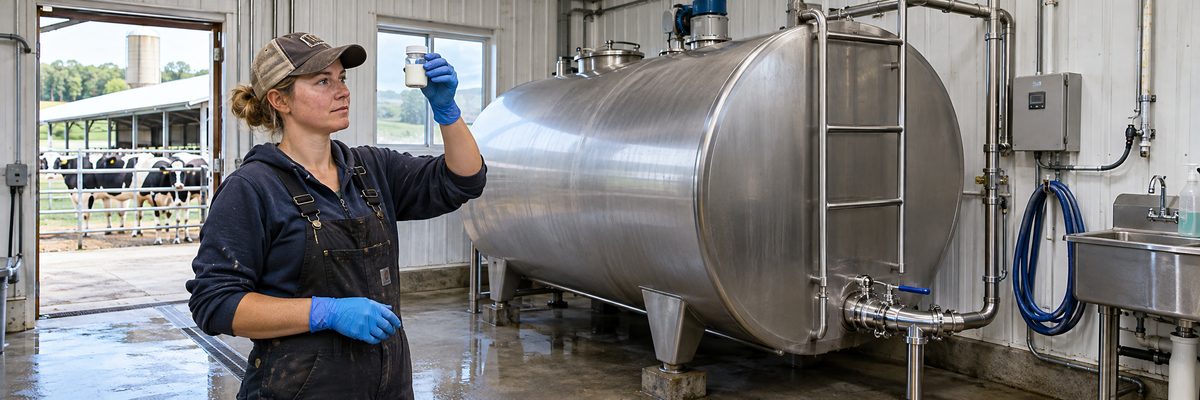
A plate cooler is a heat exchanger that sits in the milk line between the receiver and the bulk tank. Warm milk passes on one side of thin stainless plates, cold well water passes on the other, and heat moves from the milk to the water before the milk ever reaches the tank. The compressor then has far less to do.
University of Wisconsin Extension's bulletin on well water precoolers notes that milk can be dropped by as much as 40°F with a properly sized and installed unit, which can cut refrigeration energy for milk cooling by roughly 60 percent. Those are best-case figures from a well-designed system, and your own result depends on water temperature, flow and plumbing.
The idea is almost embarrassingly sensible: your cows drink a lot of water, the water is already cold, and the milk is already hot. Put them next to each other for a few seconds and let physics do the work.
How it works
Milk comes off the cow at around 95 to 98°F. Well water in many northern states sits in the low-to-mid 50s year round, though yours may differ with depth and region. In a good counterflow setup the water and milk travel in opposite directions, and milk can come out within a few degrees of the incoming water temperature.
The warmed water is not wasted. Most farms route it to the cow waterers, to a storage tank, or to the wash system, which is why a precooler is often a water-reuse project as much as an energy project. Water used as a coolant must meet potable standards, so ponds and streams are not an option, and if the warmed water will be used for drinking or washing, state and local plumbing and sanitation rules apply.
Plate or tube?
Two designs dominate. Plate-type units are compact and can be expanded by adding plates; shell-and-tube units are fixed in size. Plate coolers are the more common choice on U.S. dairies largely for that reason.
What it does for milk quality
Faster cooling is the quality angle. Milk that reaches the tank already chilled spends less time in the temperature range where bacteria multiply quickly. It also helps a tank that is marginal on the Grade A cooling requirement, particularly when a long milking sends a lot of warm milk into the tank late in the cycle.
A precooler does not clean up dirty milk. If a count is high because of equipment or udder prep, a heat exchanger will just deliver the same bacteria at a lower temperature. Cooling is one link in the chain.
Sizing: water flow is the catch
The plate cooler is cheap compared with the plumbing that feeds it. For best results the water flow should be at least equal to the milk flow, a 1:1 ratio, and the UW bulletin points out that a typical 1 horsepower milk pump moves around 35 gallons per minute. That means a supply line of about an inch in diameter, and plenty of older barns have half-inch pipes and a pressure tank that quits after a couple of minutes.
Many farms end up running closer to half a gallon of water for each gallon of milk because the well system cannot keep up. You still get cooling, just less of it.
Ways around a weak water system
- A larger pressure tank or a second one to cover short bursts.
- A storage reservoir that fills between milkings and feeds the precooler during the peak.
- A variable speed milk pump that slows the milk flow so the water ratio improves.
- A solenoid valve so water runs only when the milk pump runs. If you add one, install a water hammer arrester or the pipes will tell you about it loudly.
A well-run system is also designed so the water is not simply sent down the drain. Pumping and disposing of wasted water has a cost, and the extension bulletin treats reuse as part of the math.
Cost and payback
I will not quote a payback period, because it depends on your electric rate, the compressor, the herd and how much of the warmed water you can actually use. What does hold up in the research: the bigger your daily milk volume and the hotter your climate, the more a precooler tends to offset. Penn State Extension offers a well water precooler energy calculator that lets you plug in your own herd and electric costs before you buy anything.
Get at least two quotes, ask for the expected outlet milk temperature at your water temperature and flow, and ask who services the unit. A precooler that nobody maintains makes a fine coat rack.
Cleaning and maintenance
Anything the milk touches must be washed and sanitized, and plates are no exception. Gasketed plate packs need to be cleaned in place with the milking system and checked for leaks, because a failed plate can let water into milk or milk into water. Ask the installer how the unit connects to the wash circuit so that wash solution actually flows through it at the right velocity. The flow rates during washing can be considerably higher than during milking, and a poorly planned precooler can cause wash water to back up in the receiver.
Build the check into your pipeline wash routine and look at the plates periodically for scale, since hard water can foul the water side. Hard water is more of a problem in the Mountain West, which complicates cleaning in general there.
Precooler and heat recovery: a warning
Many dairies also have a refrigeration heat recovery unit that captures compressor heat to warm wash water. The two compete: a precooler takes load off the compressor, which means the recovery unit has less heat to recover. Run the numbers before installing both, or you may be paying for two systems that each undo part of the other.
Quick answers
Does a plate cooler replace a bulk tank?
No. It lowers the milk temperature before the milk gets to the tank, and you still need the tank and its compressor to finish cooling and hold the milk cold. What changes is how hard the compressor has to work.
Can I use pond water in a milk precooler?
No. The water must meet potable water standards, which is why wells are the normal source. Surface water can carry contaminants that do not belong near milk equipment.
Where does the warmed water go?
Most farms send it to cow drinking troughs, to storage for reuse, or into the wash system. Check your state and local plumbing rules before routing it to anything people or milking equipment will use.