Penn State Shaker Box: Checking Particle Size
The Penn State particle separator, often called the shaker box, is a stack of plastic trays with holes in them. It costs less than a decent set of tires, never needs an update, and tells you something your ration software cannot: how long the feed really is when it lands in front of the cows.
That matters because particle size drives cud chewing, and cud chewing drives saliva, the buffer that keeps the rumen from going sour. A ration can be balanced to the decimal and still cause trouble if the forage is pulverized or if the cows are picking out the long pieces.
This is how to use the box, what the numbers mean, and what to change when they are off.
What the Box Measures
Penn State Extension describes the separator as a tool to determine particle size distribution in forages and TMR. The older three-tray version has screens with 0.75-inch and 0.31-inch holes plus a solid pan. The newer version adds a fourth tray with 0.16-inch (4 mm) holes, which allows an estimate of physically effective fiber, usually shortened to peNDF.
Here is what each tray catches, according to Penn State:
- Top screen (0.75 inch): long particles that float in the rumen, form the forage mat, and take substantial extra chewing.
- Middle screen (0.31 inch): mid-length forage that still sits in the mat but breaks down faster with less chewing.
- Lower screen (0.16 inch): small forage pieces that hydrate quickly and add a smaller, but real, buffering effect.
- Bottom pan: fines. Fine particles and soluble material pass through the rumen quickly.
The extension guide also notes that a cow fed the right fiber of the right size can make roughly 25 to 50 gallons of saliva a day. That saliva is the primary buffer. A box of plastic trays is a pretty cheap way to protect it.
How to Run a Sample
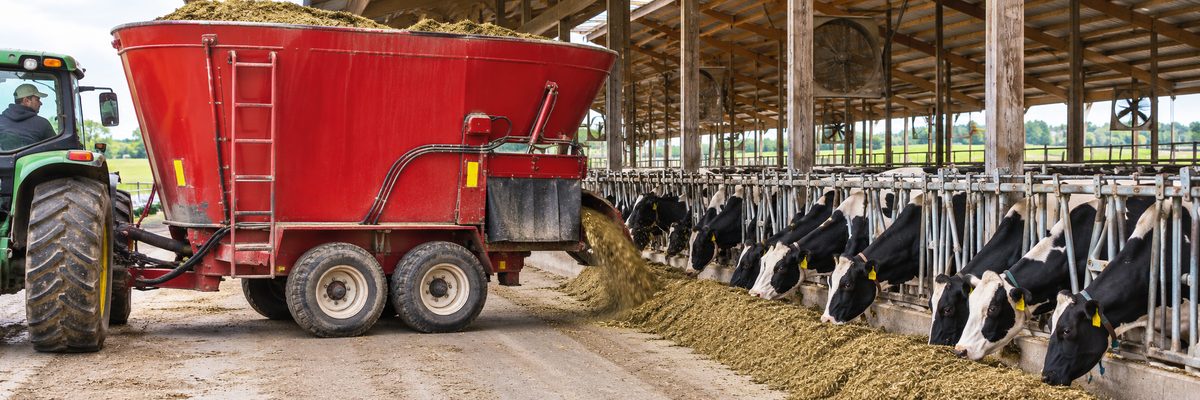
Penn State recommends sampling TMR fresh from the feed bunk, before the cows eat or sort it, so you see what was delivered. Mixing and delivery equipment can change particle size, so test the ration at the bunk, not in the mixer.
- Collect feed. Take a handful from several spots along the bunk and mix them into a bucket. A single scoop from the first foot of the bunk is not a fair sample.
- Stack the trays. Put the top screen on the middle, the middle on the lower, and the lower on the pan, on a flat surface.
- Load the top tray. Use the amount your box instructions call for, usually a few pints of feed.
- Shake. The usual routine is a set of back-and-forth strokes in one direction, a quarter turn, and another set, repeated until you have gone full circle a couple of times. Follow the instructions that came with your box or the Penn State video, since the exact number of shakes matters for comparing results.
- Weigh each tray's contents. A kitchen scale works. Tare out the empty tray each time.
- Calculate percentages. Divide each tray's weight by the total.
- Write it down. Date, pen, location in the bunk, and anything unusual.
Do not skip step seven. A number with no label is how a dairy ends up arguing with its own memory.
Target Ranges
These are the lactating-cow guidelines Penn State publishes for the four-screen version, as percent of sample on each screen.
| Screen | Corn silage | Haylage | TMR |
|---|---|---|---|
| Upper (0.75 inch) | 3 to 8 | 10 to 20 | 2 to 8 |
| Middle (0.31 inch) | 45 to 65 | 45 to 75 | 30 to 50 |
| Lower (0.16 inch) | 20 to 30 | 30 to 40 | 10 to 20 |
| Bottom pan | under 10 | under 10 | 30 to 40 |
Penn State adds some nuance. If corn silage is the only forage, at least 8 percent should land on the top screen, compared with a minimum of 3 percent when it is not. They also note that corn grain remaining on the 4 mm screen should be discounted when estimating peNDF, and that many byproducts also land there. Use judgment, and consider the ration as a whole.
A word on the older three-tray box: its target ranges differ a bit from the table above, with the TMR top tray around 5 to 15 percent in Kentucky extension's version. Always compare results to the guideline that matches the box you own.
Reading the Results
Too much on the top screen
That points to long, coarse forage, usually dry hay or long-chopped haylage. Cows will sort it out. Look at sorting and consider chopping or processing the hay, or reducing it.
Too little on the top screen
The ration probably has too little effective fiber. Check chop length at harvest, silage unloader behavior and mixing time. A new mixer or freshly sharpened knives can shred forage faster than you expect.
Too much in the pan
Lots of fines suggests overmixing, finely ground feed or a very fine forage chop. Rations like this can contribute to low rumen pH, low fat tests and loose manure. See signs of subacute rumen acidosis and feed causes of low milk fat.
Different results from fresh feed and leftovers
Compare the fresh sample to a sample of what is left a few hours later. If the leftovers have far more on the top screen than the fresh feed, cows are sorting. This is probably the most useful use of the box.
When to Test
- When forage type changes, such as new corn silage, a new cutting of haylage or a different hay lot.
- After buying a new mixer or after repairing or sharpening knives or augers.
- When milk fat drops or manure changes without a clear reason.
- After you change the loading order or mixing time.
- Regularly, as a routine check, so you have a baseline to compare against.
Penn State's guidance reminds readers that particle size is only one piece, and that peNDF by itself will not guarantee a balanced diet. Starch level and fermentability still affect rumen pH in high-producing cows. Use the box alongside your ration report and your nutritionist's judgment.
Common Mistakes
- Testing the mixer instead of the bunk.
- Taking one sample from the first foot of the bunk.
- Letting different people shake the box different ways, then comparing results.
- Forgetting to clean the screens. Sticky wet silage left in the holes will skew the next sample.
- Reacting to a single bad number instead of a trend.
The shaker box is a tool for managing cows, and it will not hold a grudge if you borrow it, only if you return it dirty. Sometimes the fix is boring: slower mixing, a sharper knife, a hay chop that is a little shorter.
For the full guide and sieve details, read Penn State's page on the particle separator.
Quick answers
Can I use the shaker box on dairy goat or sheep rations?
The guidelines are built for lactating dairy cows, so they do not transfer neatly. You can still use the box to compare batches and spot fines or sorting, but ask your nutritionist or extension office for small-ruminant targets.
How often should I test the TMR?
Test whenever forage, mixer or mixing procedure changes, and make a routine check part of your schedule. A quick fresh-versus-leftover comparison is worth doing any time cows seem to be sorting.
Where do I get a particle separator?
Many nutritionists and extension offices have one to borrow, and dairy supply companies sell them. Ask before you buy, since a borrowed box and a demonstration beat a new one in the closet.