Barns, Cow Comfort & Equipment
Parallel, Herringbone or Rotary: Picking a Parlor
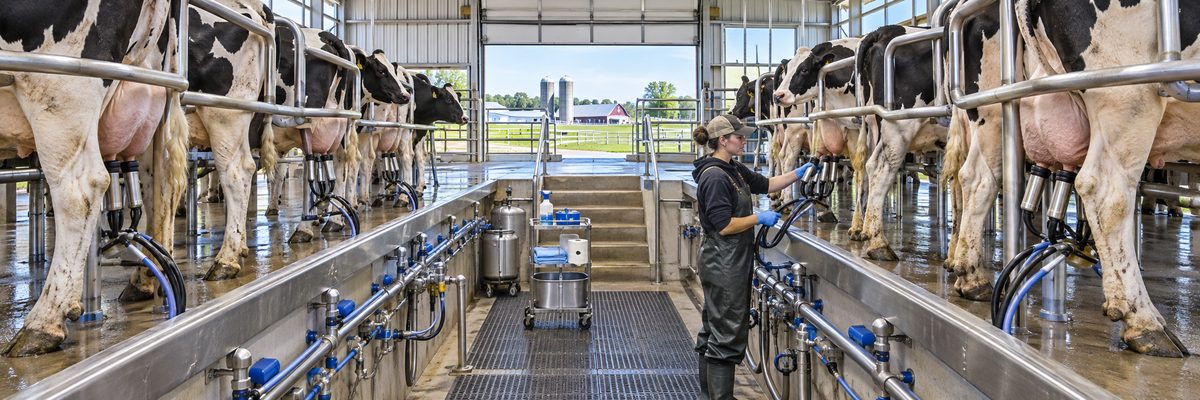
A parlor is the machine you will use more than any other on the farm. It runs two or three times a day, every day, for decades, and every mistake in its design gets repeated about a thousand times a year. That's a good reason to pick it carefully and a worse reason to pick it because a salesman had a nice truck.
The rough sort goes like this. Herringbone and parallel parlors are the workhorses for small to large herds, with parallel often preferred where speed and operator access matter. Rotary parlors make sense for large herds that need to move lots of cows with a small crew. Swing parlors suit grazing and small dairies on a budget. Robots are a different animal altogether. The right pick depends less on the brochure than on how many cows you milk, how many people you can keep, and how many hours you're willing to stand in a pit.
Herringbone parlors
In a herringbone, cows stand at an angle to the operator pit, like the bones of a fish, and you reach the udder from the side. It's the classic design and still common, particularly on small and mid-size dairies and in older conversions. Cows enter and leave in groups, and the operator works along one or both sides of the pit.
Strengths: Familiar and well understood, with plenty of dealers, used equipment, and local know-how. Works well at small to moderate scale. You can see cows' heads and udders in a pattern that makes it easy to spot problems.
Limits: Cows take up more length per stall than in a parallel layout, so the parlor gets long as it grows. Access to the udder is from the side, which some operators find less comfortable for attaching units. As herd size rises, the pit stretches, and walking distance and labor start to add up.
Parallel parlors
In a parallel (sometimes called side-opening) parlor, cows stand side by side, perpendicular to the pit, with their rear ends toward the operator. Units are attached from behind and between the hind legs. Because cows are packed tighter, a parallel parlor is shorter than a herringbone with the same number of stalls, and operators are close to every cow.
Strengths: Compact, good visibility, and easy access to udders and rear legs. Often favored in new construction for mid-size to large herds. Many operators find the work position more efficient, and routines are easier to standardize across shifts.
Limits: Cows are close together, so cow size mix and stall width matter. A pen with a mix of big Holsteins and smaller Jerseys can be a challenge, and cows that kick feel closer to your face than you'd like. Operators need training to work safely from behind.
Rotary parlors
A rotary parlor is a carousel. Cows step onto a platform that rotates slowly, get prepped and attached as they come around, and step off when milking is done. Operators stay in fixed positions while the cows move, which makes it a good fit for large herds that need steady throughput with specialized jobs: one person preps, one attaches, one handles dipping and exit.
Strengths: Efficient labor for big herds, consistent routine, and a high rate of cows milked per person hour. The pace is steady, which also tends to produce a smoother milking routine.
Limits: Higher cost, more complex equipment, and more dependence on every part working. A stuck cow or a malfunction can slow the whole carousel. Smaller herds rarely get enough volume to justify it, and the service demands are real. Some farms that went rotary too early found they bought capacity they didn't use.
Where swing parlors and robots fit
Not every herd belongs in one of the big three. A swing parlor lets one set of milking units serve two sides, so cows are loaded on one side while the other is milked. It's a low-cost option often used on grazing and smaller dairies, and the low-cost swing parlor for grazing dairies covers how that works in practice. For farms thinking beyond parlors, robots shift the labor picture entirely, and the real cost of a robotic milker is the place to begin comparing.
Comparing the main types
| Type | Typical herd fit | Labor profile | Main tradeoff |
|---|---|---|---|
| Herringbone | Small to mid-size herds | Operators work in the pit alongside the cows | Gets long as it grows |
| Parallel | Mid-size to large herds | Close access, efficient operator position | Tight cow spacing, size mix matters |
| Rotary | Large herds | Fixed positions, specialized jobs, strong throughput per person | High cost, more complex, dependent on uptime |
| Swing | Small and grazing herds | Simple, low-cost, one person can run it | Slower, not for large herds |
Herd size thresholds are not hard lines. Rotary parlors tend to appear in large operations, while small herds usually stay with simpler designs, and the zone in between is where good design work and real numbers from similar farms matter most. Many farms also choose a parlor size that allows for growth in cow numbers, but oversizing is expensive, and so is under-sizing.
What to weigh besides the type
- Time in the parlor per group. A common target is to keep cows' total time away from feed and stalls reasonable, so milking doesn't eat into resting time. The holding pen matters as much as the parlor. Cooling and comfort there are covered in cooling the holding pen before milking.
- Labor and skill. Can you hire and keep people who will do the same routine, every time? A parlor built for three operators doesn't run itself when two show up.
- Cow flow. Entry and exit lanes, crowd gates, and return alleys all affect throughput. A fast parlor with a bad exit is a slow parlor.
- Heifer training. Parlor design affects how easily first-calf heifers learn the routine. See training first-calf heifers for the parlor for how that goes.
- Milking routine. The system should make a consistent milking routine easy, since consistency is where much of the milk quality comes from.
- Cost and service. Ask about installation, utilities, wash systems, maintenance, and who services it nearby. Equipment is only as good as the technician who answers the phone.
- Future plans. If you might add cows, change shift length, or go to a different system later, say so up front.
Before you commit
- Visit at least three farms with each type you're considering, at milking time, not on a slow afternoon.
- Ask the operators what they'd change. The answers are usually worth the drive.
- Run your numbers on labor, cow numbers, and cash flow using the numbers-first approach to a dairy expansion decision.
- Get design input from an independent source, such as extension or a parlor consultant, along with the dealer's proposal.
- Check state and local requirements, including milk inspection rules for construction and layout.
For design principles and research on milking systems and facilities, the UW-Madison Dairy extension articles are a trusted starting point, and many land-grant universities also offer parlor design guidance and consulting.
The best parlor is the one your crew can run well at five in the morning with a cow in the exit lane who has decided she lives there now. Everything else is just steel and paint.
Quick answers
Is a parallel parlor better than a herringbone?
Parallel parlors are more compact and give easier udder access, which is why they're popular in new builds. Herringbones work well and are familiar, especially at smaller scale. The right choice depends on herd size, cow size, and how you'd rather work.
How many cows do I need to justify a rotary parlor?
There is no single number, because it depends on labor, shifts, and capital. Rotaries generally make sense for large herds that need high throughput with a small, specialized crew. Smaller herds usually find simpler designs a better fit.
What is the cheapest way to milk a small herd in a parlor?
Swing parlors and small herringbones are commonly used on small and grazing dairies because they keep costs down. Used equipment can help, but inspect it carefully and have the vacuum system tested before you buy.