Youth, Shows, Careers & Dairy Life
Identifying the Six Dairy Breeds on Sight
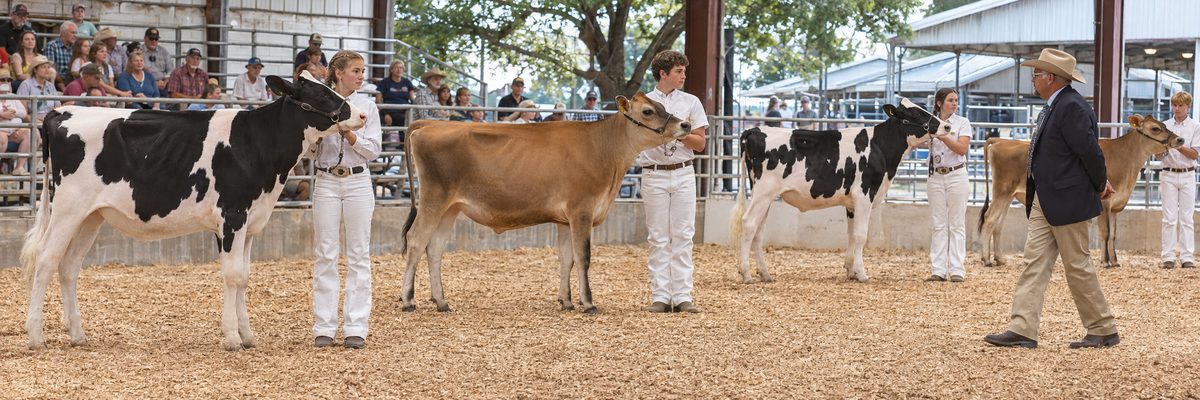
Six dairy breeds show up in most American contests and show rings: Holstein, Jersey, Guernsey, Brown Swiss, Ayrshire and Milking Shorthorn. Three of them you can name from the road at highway speed. The other three get mixed up on a regular basis, mostly by people who are fine on a Tuesday and wrong on contest day.
The trick is to stop looking at everything and look for the one or two features that sort each breed from its lookalikes. Color is the first cut, size is the second, and a handful of small details finish the job. Use this as a study sheet, and then go look at real cattle, because a list is not a cow.
Start with color, then ask about size
University of Kentucky Extension publishes a handy dairy cattle breed summary with origin, color and typical mature cow size for each breed. The sizes below are averages from that page, so a real cow can run above or below them.
| Breed | Color | Typical mature size |
|---|---|---|
| Holstein | Black and white or red and white, with clearly defined markings | About 1,500 pounds |
| Jersey | Varies, but typically a shade of fawn, with or without white | About 1,000 pounds |
| Guernsey | Light to dark fawn, solid or with white, with a golden yellow cast | About 1,200 pounds |
| Brown Swiss | Solid brown from very light to dark | About 1,500 pounds |
| Ayrshire | Cherry red or mahogany, with white | About 1,250 pounds |
| Milking Shorthorn | Red, red and white, or roan; no black | About 1,400 pounds |
The easy three
Holstein
Black and white, big frame, and the most numerous dairy breed in the country. If the markings are sharp and clean, it is probably a Holstein. The catch is that Holsteins also come in red and white, which is where some people go wrong in the ring. Red-and-white Holsteins have the same clearly defined patches as the black ones, with red replacing black, and they carry the big, tall Holstein frame.
Brown Swiss
One color, brown, and big. Kentucky's summary notes the shade varies from very light to dark, and that the nose is black with a lighter ring around it, while the tongue and hooves are dark. A solid brown cow with Holstein size is a Brown Swiss. Brown Swiss are also known for good feet and legs and a calm temperament. While you are on the subject of size, this farm.FM piece on how Brown Swiss cows got so big treats it as a mystery that has scientists scratching their heads. The real answer involves a cow bred in Switzerland, which is less exciting but more accurate.
Jersey
The smallest of the six, with a dished face and large dark eyes, in most cases. Jerseys come in a range of fawn shades and may carry white, and the breed is valued for high milk solids and, according to the Kentucky summary, heat tolerance and fertility. Fawn plus small is your clue.
The ones that get confused
Guernsey vs Jersey
Both are fawn-colored. Size helps (Guernseys are bigger), but the better tell is the golden cast. Guernseys are known for a golden yellow pigmentation, and the breed is associated with milk that is high in beta-carotene. If you are looking at a fawn cow and wondering which it is, ask how big and how golden.
Ayrshire vs red-and-white Holstein vs Milking Shorthorn
This is the trio that causes the most grief, because they share red and white.
- Ayrshire: deep cherry red or mahogany with white, and the breed is also known for upward-curving horns on cattle that still have them. Not every show animal has horns anymore, so use color and overall style first.
- Red-and-white Holstein: a Holstein frame, large and tall, with markings that are crisp and well defined.
- Milking Shorthorn: can be red, red and white, or roan, which is a mix of red and white hairs that gives a speckled, blended look. The roan is the giveaway, and no black is allowed in the breed.
When in doubt, ask whether the white is in sharp patches (Holstein), a red cow with white and a cherry or mahogany color (Ayrshire), or blended into the coat (Milking Shorthorn roan).
Beyond color: a few secondary clues
- Frame and size. A Jersey stands noticeably shorter and lighter than a Holstein or Brown Swiss in the same pen.
- Head and face. Look at the muzzle and the shape of the face. Jerseys tend to look refined and dish-faced, while Brown Swiss look broad and strong through the head.
- Skin and nose. The dark nose with a light ring on the Brown Swiss, and the golden cast on the Guernsey, are two of the most reliable details.
- Udder style. Breeds have different strengths. Kentucky notes that Ayrshires are known for strongly attached, well-shaped udders, for example.
How to practice
- Print a set of side-view photos from the breed associations' websites, such as the Ayrshire and Brown Swiss associations, and cover the labels. Sort them into piles.
- Take the stack to the county fair and ask the exhibitors if you got them right. They will tell you, in detail.
- Write one sentence per breed that starts with "I know it is a ___ because ___." The reason matters as much as the guess.
- Add the rest of the picture: how the breeds compare on size, milk and temperament.
Breed ID shows up in quiz bowl and skillathon stations as well, usually as photos or live animals, so it pays off across contests. If you are building a study plan, the dairy quiz bowl study guide and skillathon prep both include it. For a farmer's view of the same breeds, see Holstein versus Jersey.
Quick answers
How can you tell a Jersey from a Guernsey?
Jerseys are smaller and tend to be a more uniform fawn, while Guernseys are bigger and carry a golden yellow cast, often with clear white markings. If you are unsure, size and the golden color are the best clues.
Are red-and-white Holsteins a different breed?
No. A red-and-white Holstein is still a Holstein, with red in place of black in the pattern. Look for sharply defined markings and the large Holstein frame to tell it from an Ayrshire or Milking Shorthorn.
Which dairy breed is the biggest?
Holsteins and Brown Swiss are the largest on average, at about 1,500 pounds for a mature cow. Jerseys are the smallest, at roughly two-thirds of that.