Youth, Shows, Careers & Dairy Life
Judging Dairy Cow Udders, Feet and Legs for Beginners
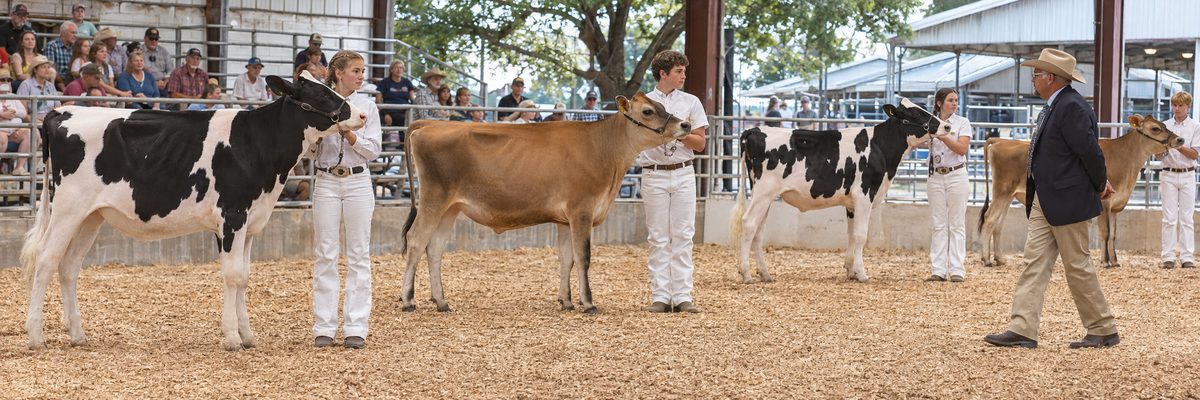
Judging dairy cattle looks like magic when you watch a good judge work. The class walks by, the judge studies them for about a minute, and then somehow it is a placing and a set of reasons. It is not magic. It is a trained habit of looking at the same few traits, in the same order, and comparing one cow against the next. Learn the traits and you can do a decent job on your first class.
The traits that carry the most weight are the udder, the feet and legs, dairy strength and frame. A cow that has a well-attached, balanced udder, strong correct legs that let her walk freely, a lean, open, angular build and enough size and stature is a good dairy cow. Almost everything else is a variation on those four things.
How the scorecard divides the points
Different organizations weigh traits a little differently, but the shape is consistent. The University of Kentucky's 4-H dairy resource lists four categories for a dairy cow: udder at 40 points, dairy strength at 25 points, rear feet and legs at 20 points and frame at 15 points. That adds up to 100, and it tells you where to spend your time. Udder gets the most, which makes sense because the udder is where the cow earns her living. Dairy strength comes second, and legs still outrank frame, since a cow who cannot walk comfortably will not last long in a herd.
For a four-cow class in a judging contest, your job is to figure out what is correct and incorrect about each animal and rank them from the most correct to the least. A useful rule is to remember that the best cow is not the one with no faults, because none of them are perfect. It is the one with the most important strengths and the fewest serious problems.
A simple order for looking
- Stand back and look at the whole cow. Is she tall, long and balanced, with a straight topline and a level rump? That is frame.
- Look at dairy strength. Is she clean and angular, with open ribs and a long neck, or thick and coarse?
- Move to the side and rear for the udder. Look at attachment, height, width and balance.
- Look at the legs while she walks. A cow standing still can hide a lot. Watch her stride.
- Compare. Decide which cow is best in each trait and weigh them by the points.
Practice on real cows. Barn visits beat pictures, and a dairy farmer who lets you look at the herd is giving you a free lesson, so say thank you and offer to help with chores.
Udders
The Kentucky page describes the udder of a cow that excels like this: it is appropriate in size and capacity for her age and number of lactations, with a moderately long fore udder that blends smoothly into the body wall. It also has a level udder floor, well above the hocks, a full and wide rear udder, a high and wide rear udder attachment, balanced quarters, evidence of a strong median suspensory ligament and plenty of veining. Teats should be moderate in size and length, placed squarely under the quarters and pointing straight down.
A cow that does not excel may have a bulgy fore udder or a loose attachment. She may have an udder floor that slopes or tilts back, or an udder floor that hangs below the hocks. Other faults include a flat and narrow rear udder, a low and narrow rear attachment, unbalanced quarters, a weak median suspensory ligament, and teats that are the wrong size or shape. In plain words, a good udder sits up high, hangs level and holds together. A bad udder hangs low, droops and looks like it is giving up.
Why it matters: an udder attached high and tight stays out of the way, resists injury and holds up as the cow ages. A low, pendulous udder is a bigger target for injury and is harder on the milker.
Feet and legs
Rear legs show the most in a judging class. According to the Kentucky resource, a cow with correct rear feet and legs has hind legs placed squarely under her, a moderate set or curve to the hocks, clean hocks, short strong pasterns, a deep heel and a steep foot angle. When viewed from behind, the hind legs are straight, and she walks with an easy, smooth stride.
Faults to watch for include:
- Too much set to the hocks (sickle-hocked) or hocks that are too straight (post-legged).
- Swelling or puffiness in the hocks.
- Weak pasterns and heels that are too shallow.
- A low foot angle.
- Cow-hocked, where the hocks turn in when viewed from the rear.
- A restricted, uncomfortable stride.
On the front legs, the same resource asks for hooves that point straight forward and straight legs set square under the body. Toes that turn in or out and crooked legs are faults. For the bigger picture of why feet and legs matter to a herd, what causes lameness in dairy cows explains how foot problems affect a cow's life, and how often to trim dairy cow hooves shows how farms keep feet in shape.
Dairy strength and frame
Dairy strength is the look of a cow built to convert feed into milk. Kentucky describes it as a feminine head, a long lean neck, sharp angular withers, a long barrel with plenty of space between flat ribs, a flat lower leg and a wide, deep chest and rib. A cow lacking it may have a short, coarse head, a thick neck, round withers, round ribs and a narrow chest. Frame means she is tall, long from muzzle to pins, straight in her lines and balanced, with a long, wide rump and moderate slope from hooks to pins. A faulty frame may be low set, short bodied, sway backed or steep in the rump.
Which brings up a classic judge's reminder: say what she is, not what she isn't. The University of Georgia Extension publication on dairy judging terminology is a good guide to the vocabulary, and it will save you from describing a cow as "not bad."
Putting it into a placing
Once you have your notes, rank the class. If the top two cows are close, ask which one is better in the traits that carry more points. A cow with a better udder and a little worse frame usually beats the reverse. When it is still close, pay attention to leg quality and how she walks, since that is hard to fake. Once you have a placing, you will have to defend it. How to give oral reasons in dairy judging shows how to turn your notes into a clear set of reasons, and dairy judging contest tips for FFA teams goes further on contest strategy. For the show side of how classes are sorted before a judge ever places them, see dairy cattle show classes explained by age and division.
Mistakes beginners make
- Falling in love with one trait and ignoring the rest.
- Judging the cow's color or the halter. Black and white is not a trait.
- Looking only at the udder and forgetting that a sore-footed cow will not use it for long.
- Not watching the cow walk.
- Changing your placing at the last minute because the person next to you looked confident. Confidence is not a trait either.
The University of Kentucky's page on judging dairy cattle has labeled photos and plain descriptions for each trait, and it is worth bookmarking before your first contest.
Quick answers
What matters most when judging a dairy cow?
The udder usually carries the most weight, followed by dairy strength and feet and legs, with frame last. One university scorecard uses 40, 25, 20 and 15 points for those traits.
What is a sickle-hocked cow?
It is a cow with too much set to her hocks, so her hind legs curve forward too much when viewed from the side. The opposite fault is post-legged, with hocks too straight.
How do I get better at judging?
Look at lots of cows, practice with a team or a leader and write down your reasons. A dairy farm visit, a barn full of cows at the fair and a judging practice are all useful. The more you compare cows in person, the faster you see the differences.