Grazing, Organic & Small Dairies
How Much Grain Do Grazing Dairy Cows Really Need?
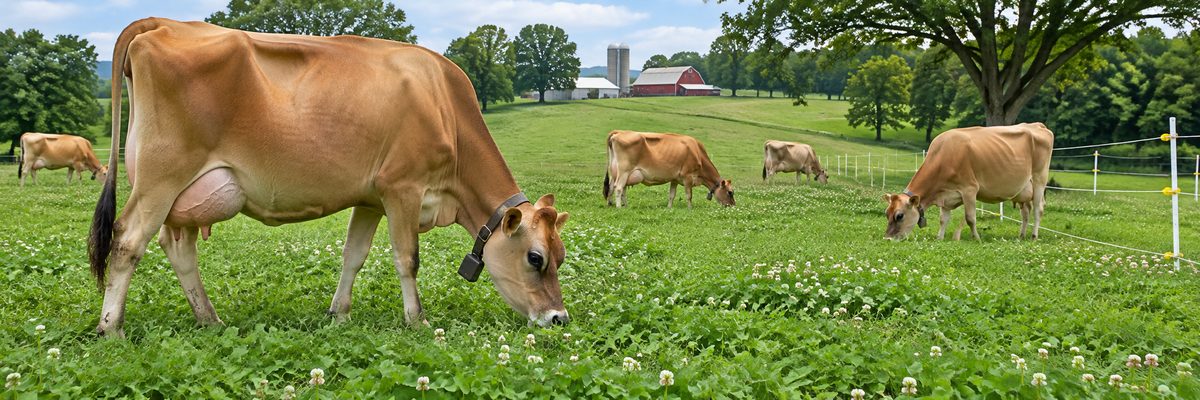
The honest answer is: as much as it takes to fill the gap between what the cow needs and what the pasture actually delivers, and no more. That gap moves with the season, the paddock and the cow. Lush spring grass can be so high in protein and so low in fiber that the cow needs energy and roughage more than she needs a scoop of grain, while a short, dry August paddock may need a lot more help. Cows do not, as a rule, read the feeding chart taped to the parlor wall.
Pasture is an excellent feed, but cows eat less of it than most people assume, and a high-producing cow can't carry her whole milk production on grass alone without losing condition. The skill is in estimating what she ate, then balancing the rest with the right feed, not just more grain.
Start with what the cow needs
A fresh, high-producing cow has very high energy demands, and intake is her limit. Penn State Extension notes that formulated rations for dairy cows in Pennsylvania typically run 48 to 52 pounds of dry matter intake, and that if you assume the cow will eat more pasture than she really does, milk production can suffer, with cows pulling body stores, losing condition, breeding back later and giving less milk. Read their piece on grazing management for organic, grass-fed or conventional dairies for the intake method.
Their worked example is a good template. If a paddock has an estimated 1,700 pounds of forage as fed, grazed for two days by ten cows, each cow gets about 85 pounds of fresh pasture a day. At 20 percent dry matter that is about 17 pounds of dry matter, which leaves a gap of 33 pounds against a 50 pound ration to fill with stored forage and concentrates. The numbers are theirs, and yours will differ, but the arithmetic is the habit to learn: measure the paddock, estimate dry matter, subtract from the target, then feed the difference.
What pasture looks like nutritionally
Pasture quality swings a lot. Penn State Extension reports Dairy One forage lab data on tens of thousands of pasture samples: crude protein averaged around 16 percent of dry matter, but with a wide spread, and the article describes protein ranging from about 8 to 23 percent and fiber from about 46 to 72 percent, most likely reflecting spring, summer and fall differences. That spread is the reason a fixed grain amount fed all season rarely fits. You can see the figures in their article Dairy Sense: Utilizing Pasture.
Typical patterns to expect:
- Spring flush: High protein, high moisture, lower fiber. Cows often need effective fiber from hay or baleage and a source of energy that doesn't make protein excess worse.
- Early summer: Quality still decent but growth slows. Intake can drop as paddocks get shorter.
- Midsummer: Heat reduces both intake and pasture growth, so more of the ration comes from stored feed.
- Fall: Cool weather brings back leafy regrowth that is high quality, though dry matter intake per bite can be low.
What goes into the supplement
"Grain" is shorthand. What the pasture-fed cow needs is a balance of energy, rumen-degradable carbohydrates and effective fiber, with protein only where the pasture is short. A herd nutritionist will usually look at a few levers:
| Pasture situation | Common supplement approach (general) |
|---|---|
| Lush, high-protein, low-fiber spring grass | Energy source such as ground or high-moisture corn, plus dry hay or other long fiber; limit extra protein |
| Mature or short, lower-quality pasture | More stored forage plus balanced concentrate, since cows can't eat enough |
| Hot weather with reduced intake | Nutrient-dense feed, good water and shade, with care for rumen health |
| Fresh cows in early lactation | More concentrate, closer attention to condition and ketosis risk |
| Late lactation or dry cows | Mostly pasture, minerals and little grain |
How much grain this adds up to varies a great deal by herd. Many grazing herds feed some grain in the parlor to fresh and high-producing cows and much less to late-lactation cows, and amounts range from little to quite a lot depending on production goals. Because feed ingredients, milk prices and cow genetics change, a nutritionist who knows your pasture and your milk market can set this much better than a general rule. See what a dairy nutritionist costs and what you get for how to find one.
The money question
More grain does not automatically mean more profit. Each added pound has to pay back in milk, condition or fertility. The measure to watch is income over feed cost, not just milk per cow. If a grain increase raises milk a little but costs more than it returns, you have bought volume, not profit. Penn State makes the point that monitoring must include an economic component, and that without it a grazing strategy can lose the savings it was meant to deliver. A walk through the method is in calculating feed cost per hundredweight of milk.
Organic and grass-fed herds have extra limits. Organic grain costs more, and grass-fed programs may restrict grain altogether, so check your certifier and buyer rules. Organic herds also have minimum pasture requirements, so confirm the current rules with your certifier.
How to tell if the level is right
- Look at manure. Loose, shiny, bubbly manure on lush pasture points to too much rapidly digested carbohydrate or protein and too little fiber. See using manure scoring to check the ration.
- Check milk urea nitrogen. High MUN on pasture usually means excess protein relative to energy. Understanding milk urea nitrogen on your test explains how to read it.
- Watch body condition. Cows losing condition too fast after calving need more energy or more forage in the ration, and a vet or nutritionist should look at the cause.
- Look at the pasture after grazing. If cows leave grass behind, you may be over-feeding concentrate. If they graze it to the dirt, they may need more.
- Watch for rumen upset. Lazy chewing, loose manure and drops in fat test can mean too much fast-fermenting carbohydrate. A herd vet or nutritionist can help you sort out the cause.
Mistakes to avoid
- Feeding the same grain level all season because that is what the bag said in April.
- Assuming cows eat what you hoped. Cows follow their own plan, and it rarely matches the spreadsheet.
- Skipping minerals. Pasture is rarely balanced for every mineral, and a free-choice or in-parlor program is basic insurance.
- Making big feed changes overnight. Rumens like gradual.
- Skipping water. A cow that isn't drinking isn't eating, and she isn't making milk.
Quick answers
Can dairy cows live on pasture alone?
Lower-producing cows and some breeds suited to grazing can do well on high-quality pasture with minerals, especially in a seasonal system. High-producing cows usually need supplemental energy and fiber to keep condition and fertility. Work with your nutritionist to set expectations for milk per cow.
How many pounds of grain should I feed per cow?
There is no single figure. It depends on pasture quality and quantity, stage of lactation, milk yield, breed and price of feed versus milk. Estimate pasture intake, then have a nutritionist balance the difference.
Is grain bad for grazing cows?
Not by itself. Problems come from feeding too much fast-fermenting grain with too little fiber, or from feeding it in big meals. Smaller, more frequent feedings and good fiber reduce the risk.