Heifer Growth Targets by Age: Weight and Height Charts
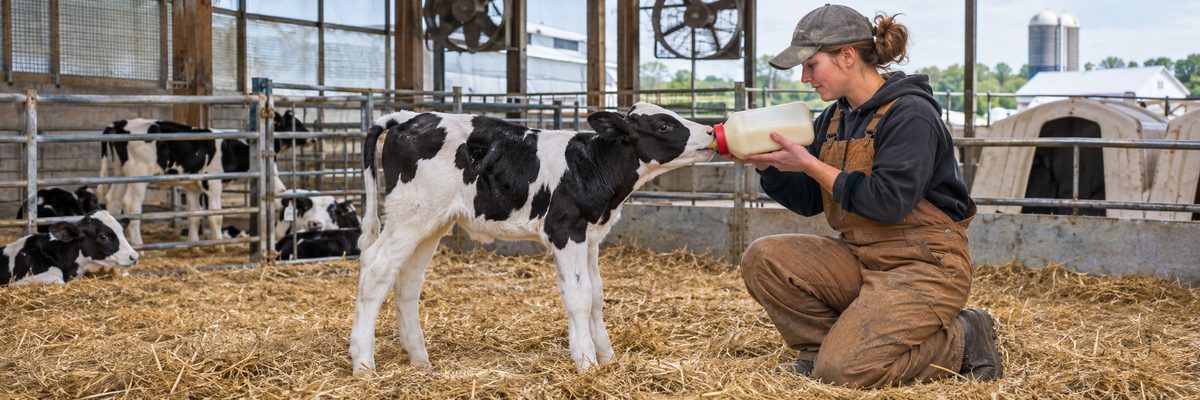
A heifer that is behind at six months is not going to announce it. She will look fine, eat fine and stand in the pen with her pen mates until you put her on the scale and discover that she is a month and a half behind the rest. By then the fix costs you feed, time and a later first calving.
The short answer: compare each group to a breed growth chart at set ages, aim to keep most Holstein heifers in the upper part of the range, and breed on size and age together, not on the calendar alone. For Holsteins, Penn State's chart recommends a range between the 75th and 95th percentile, and for other breeds a range between the average and roughly the top third of the population.
The tables below give you the numbers, with some caveats about what they do and do not tell you.
Where these numbers come from
The figures here are from Penn State Extension's growth charts for dairy heifers. They are based on measurements of a large number of heifers of various breeds across the United States, mostly from herds where the average age at first calving was a bit over 24 months. Penn State notes that heifers in that data were probably smaller for a given age than those on today's well-managed farms that calve at 22 to 24 months. So treat the numbers as a floor to compare against, not a ceiling, and talk to your nutritionist about what is realistic on your farm.
Penn State's suggested goal for Holsteins is to keep a majority of heifers near the 75th percentile and the whole herd between the median and the 95th percentile. To reach early calving, individual heifers should be near the top of the range or slightly above.
Holstein targets
Recommended range is between the 75th and 95th percentile for the age, from the Penn State data. Weights are in pounds, withers height in inches.
| Age (months) | Body weight (lb) | Withers height (in) |
|---|---|---|
| 3 | 234 to 284 | 36 to 38 |
| 6 | 422 to 480 | 41 to 44 |
| 9 | 596 to 705 | 45 to 47 |
| 12 | 760 to 843 | 48 to 51 |
| 15 | 931 to 1,067 | 51 to 53 |
| 18 | 1,066 to 1,191 | 52 to 54 |
| 21 | 1,191 to 1,372 | 54 to 56 |
| 24 | 1,301 to 1,545 | 55 to 57 |
Penn State also lists a separate hip height range for Holsteins, from 36 to 39.5 inches at two months, 42 to 44.5 at six, 48 to 51 at twelve, and 52 to 54.5 at eighteen. Hip height reads a little differently from withers height depending on where and how you measure, so use one method every time. For how to measure, see weighing and measuring heifers with a tape or scale.
Jersey and Brown Swiss targets
For breeds other than Holstein, Penn State's recommended ranges run between the average and the top 67th percentile (for Jerseys, the 50th to 67th). Jerseys are smaller and Brown Swiss run larger, which is the reason you should not hang a single chart on the wall for a mixed-breed herd. The scale has no opinion on how pretty your Jersey is.
| Age (months) | Jersey weight (lb) | Brown Swiss weight (lb) |
|---|---|---|
| 3 | 155 to 177 | 240 to 283 |
| 6 | 259 to 321 | 396 to 462 |
| 9 | 373 to 436 | 548 to 637 |
| 12 | 471 to 548 | 693 to 805 |
| 15 | 565 to 640 | 829 to 963 |
| 18 | 639 to 753 | 955 to 1,107 |
| 21 | 719 to 827 | 1,068 to 1,235 |
| 24 | 790 to 893 | 1,167 to 1,343 |
The Penn State charts also cover Guernsey and other breeds. If you run Ayrshires, Milking Shorthorns or crossbreds, ask your extension office or nutritionist which chart is the closest fit. Crossbreds often land between the parent breeds, but that is a starting point, not a rule.
Speaking of size, farm.FM has a tongue-in-cheek piece on how Brown Swiss cows got so big, which is a good read if you have ever wondered why a Brown Swiss heifer needs a different chart than the Jersey next to her.
What to aim for at calving
Penn State Extension's passive transfer article, citing industry work, says heifers should ideally be bred to calve at 22 to 24 months, putting Holsteins at around 1,200 pounds and Jerseys at about 850 pounds. Calving heifers that are too small raises the risk of calving trouble, and the calf and the heifer both pay for it. Pair that with a calving ease sire; see choosing calving ease sires for first-calf heifers.
Growth is not only about size at calving. Breeding heifers at the right size and age is what keeps the calving date on target. When to breed dairy heifers by age and weight goes through that decision.
What to do when heifers fall behind
Start with the likely causes before you start adding feed.
- Calf health: a heifer that had pneumonia or bad scours as a calf often stays behind. The best fix is prevention early on.
- Weaning setback: a poor transition from milk to starter can set a calf back for weeks. See a step-down weaning schedule that keeps calves growing.
- Ration and forage quality: test forage and have your nutritionist check the heifer ration against actual growth.
- Bunk space and group competition: small or timid heifers get pushed off the feed, and mixed-size groups hide the problem. Sort by size.
- Heat, cold and parasites: these all take energy that would otherwise go to growth.
Do not try to cram a month of growth into two weeks; it works on heifers about as well as it works on a person the week before a wedding. Heifers pushed too hard on energy can put on fat in place of frame, and that is not what you want in a future milk cow. Work with a nutritionist on the adjustment, and check the group again in a month.
Regional notes
Heat stress in the Southeast and Southwest can slow growth in summer, so check weights more often in the hottest months. Pasture-based herds in the Northeast and Upper Midwest often see seasonal swings in growth as forage quality changes, which is where pasture or drylot for growing heifers becomes a practical question.
Quick answers
How much should a Holstein heifer weigh at 12 months?
Penn State's recommended range is about 760 to 843 pounds, between the 75th and 95th percentile of the data it used. Your nutritionist can help set a realistic target for your herd.
What height should a Holstein heifer be at breeding?
Around 15 months, the chart shows withers height of roughly 51 to 53 inches for the recommended range. Breed on a combination of size, age and body condition, not height alone.
Do I need a different chart for Jerseys?
Yes. Jerseys are a smaller breed, and a Holstein chart will make Jersey heifers look behind when they are not. Use a breed-specific chart.