Grazing, Organic & Small Dairies
How Many Dairy Cows Per Acre Can Pasture Support?
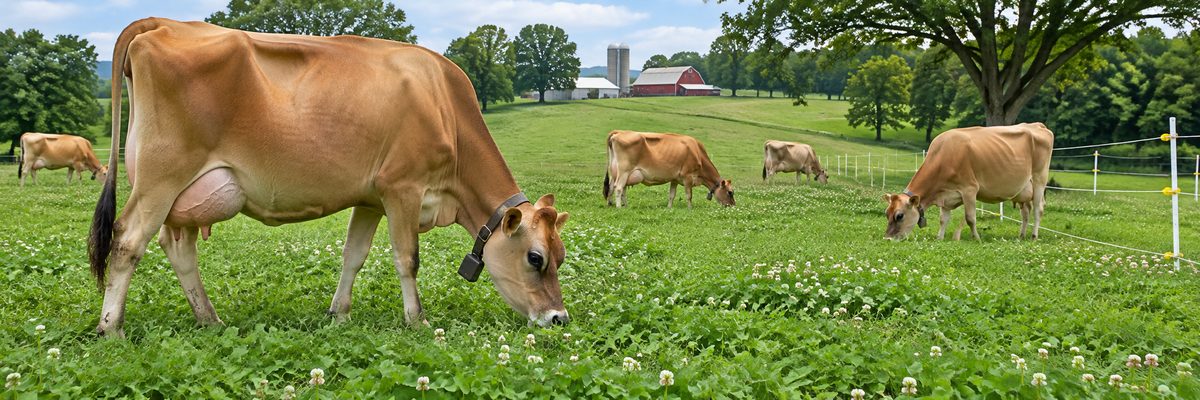
Anyone who gives you a flat number of cows per acre is guessing. The answer comes from two things you can estimate for your own farm: how much usable forage your pasture grows over the grazing season, and how much of each cow's daily intake you want it to supply. Divide one by the other and you have a starting stocking rate. Then the weather makes a fool of the math, which is why you keep a feed reserve.
As a rough range, humid regions with decent soils and good management often need somewhere around one to two acres of pasture per milking cow for the grazing season, more on thin or droughty ground, and less on irrigated, fertile pasture where growth keeps going through summer. Treat those as a conversation starter for your extension agent, not a plan.
Step one: how much does a cow need?
A lactating dairy cow eats a lot of dry matter, commonly in the neighborhood of 45 to 55 pounds a day for a high-producing Holstein, less for smaller breeds and lower-producing cows. Penn State Extension notes that formulated rations in Pennsylvania typically run 48 to 52 pounds of dry matter intake, and that an organic farm must take at least 30 percent of that from pasture. The details of intake by size and production are in how much dry matter a dairy cow eats.
Next, decide how much of that you want pasture to supply. A herd that gets half its dry matter from pasture needs about 25 pounds of grazed dry matter per cow per day. A herd that is mostly pasture-fed needs more, and a herd that grazes mainly for exercise and a few pounds of intake needs less.
Step two: how much grass can you actually use?
Pasture yield is not what the grass grows. It is what the cows eat. You will lose forage to trampling, manure patches, mature leaves and the residual you leave behind to keep the stand healthy. Many graziers plan on cows harvesting only a portion of what grows, commonly in the range of 40 to 60 percent depending on the system. Tighter paddocks and shorter stays raise that number. Lower stocking and long stays reduce it.
The Ohio State fact sheet on grazing intensity and move frequency reports that rotational grazing has been linked to an average forage production increase of about 30 percent compared with continuous grazing, which allows a higher stocking rate. That is an average, and the benefit varies a lot with soil, species and management.
To measure what you have, Penn State recommends height readings with a grazing stick in 10 to 20 spots across a paddock, and repeating them as the season changes, in their guide to grazing management for organic, grass-fed or conventional dairies. Your local extension office or NRCS soil survey will have typical yields for your soil types, which is a place to start before you have your own data.
A worked example (illustrative numbers only)
Say you want pasture to supply 25 pounds of dry matter per cow per day over a 180-day grazing season. That is 4,500 pounds per cow. Suppose your paddocks grow 3 tons of dry matter per acre over the season, which is 6,000 pounds, and cows harvest half of it. That is 3,000 pounds per acre.
- Pounds needed per cow: 4,500
- Pounds usable per acre: 3,000
- Acres per cow: 4,500 divided by 3,000, or about 1.5
So 40 acres supports roughly 27 cows at that level of pasture intake. These numbers are invented for the arithmetic, not a forecast, and you should replace each one with your own. If your pasture grows more or the cows eat less of it, the acres per cow drop. If your summer slump cuts growth in half for six weeks, you fill the gap with stored feed, or you plan for a smaller herd.
What changes the answer
| Factor | Effect on stocking rate |
|---|---|
| Soil fertility and depth | Deep, fertile soil grows more. Shallow or sandy soil caps you. |
| Rainfall or irrigation | Humid regions and irrigated ground allow tighter stocking than dryland. |
| Species mix | Well-adapted grasses and legumes grow more usable forage. Weedy stands lose it. |
| Paddock size and rest | More paddocks and proper rest raise utilization and regrowth. |
| Cow size and production | Big, high-producing cows eat more and need better quality. |
| Supplement level | More grain and stored feed means fewer acres needed per cow. |
| Season length | Short northern seasons and long southern ones change the whole equation. |
Regional notes
In the Northeast and Upper Midwest, the grazing season runs from spring green-up to late fall, with a strong spring flush, a summer slump and a decent fall. The seasonal pattern and how it changes the numbers is covered in the Northeast and Upper Midwest grazing calendar. In the Southeast, heat limits cool-season grass and cow comfort, so stocking is set by the weak part of the season, not the strong part. On irrigated West Coast and Mountain West farms, pastures often carry more cows per acre, but the farm pays for water and fertility to do it.
Mistakes to avoid
- Stocking for the spring flush. Spring will make you look brilliant and August will make you look sheepish.
- Counting acres you cannot graze, like lane, wet corners, brush and steep banks.
- Ignoring dry cows and heifers. They eat from the same acres, so count them.
- Assuming last year's rain is every year's rain.
- Skipping a feed reserve. A short season is a feed question, not a pasture question.
How to check your number
- Start with a conservative stocking rate and measure pasture growth through the season.
- Watch milk production, body condition and how short paddocks are after a graze. Cows leaving bare ground or milk dropping in midsummer both say you are overstocked.
- Check how long paddocks rest between grazings. If rest keeps getting shorter than the plants want, the herd is too big for the acres.
- Look at the supplement bill. If grain keeps creeping up to cover shortfalls, the pasture is not carrying its share, and how much grain grazing cows really need may show where the money is going.
Quick answers
How many acres does a small family dairy need?
It depends on herd size, but a rough planning figure is one to two acres of good pasture per milking cow plus ground for dry cows and heifers, with more where soil or rainfall is poor.
Is stocking rate the same for all breeds?
No. Jerseys and smaller crossbreds eat less per cow than big Holsteins, so you can carry more of them on the same acres, though per hundredweight of body weight the difference narrows. Count animal units or dry matter demand, not just heads.
Who can help me measure my pasture?
Your county extension office, NRCS field office and local grazing network can help with soil maps, yield estimates and grazing plans. Many offer free or low-cost help with plans and cost-share programs.