Youth, Shows, Careers & Dairy Life
How to Give Oral Reasons in Dairy Judging
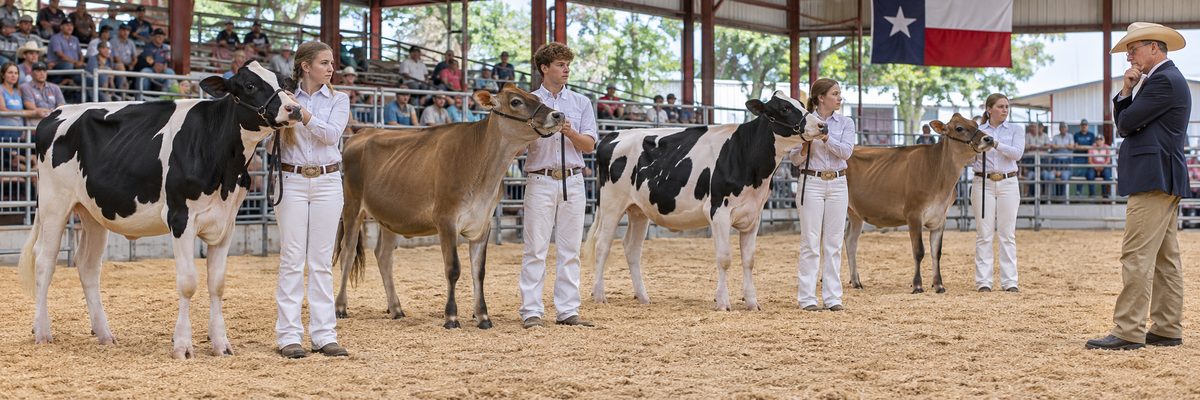
Oral reasons are a short talk, usually under two minutes, in which you explain to an official judge why you placed a class of four dairy animals the way you did. You give them from memory, in the present tense, as if the cows were still standing in front of you. Most contests score them out of 50 points, the same as the placing itself, which is why a mediocre set of reasons can sink a good placing.
The good news is that reasons are a skill, not a gift. The format is the same every time, the vocabulary is a list you can learn, and the practice routine is something you can do in the pickup on the way to the fairgrounds. The bad news is that nobody sounds smooth on the first try, and the first set you give to your mother will be about as polished as a calf learning to drink from a bucket.
What the judge is actually scoring
The coaches at University of Wisconsin-Madison who wrote a widely used guide to dairy cattle reasons say reasons are scored on organization, specificity and completeness. Notice what is not on that list: volume, speed and big words. A beginner who is accurate and a little choppy beats a smooth talker who gets the udder backwards.
University of Kentucky Extension boils it down to three parts: notes, terminology and delivery. Accurate notes plus accurate terms plus accurate delivery equals a good score. Everything in this article hangs on those three.
Take notes you can actually use
You will not have your notes in the reasons room, so the notes are for building a picture in your head, not for reading. Three kinds are worth writing while you look at the class.
- Identification notes. Anything that lets you point to a cow without a number: the roan, the heifer with the crooked blaze, the cow with the white switch. Judges hear a lot of reasons, and a vivid identifier tells them you were really there.
- Individual notes. What the top cow does better than the whole class, or what the last cow lacks. Use these only where one animal is clearly the best or worst at something.
- Pair notes. The meat of the thing. For each pair, the traits that separate them, written in comparative form: higher, wider, sharper, cleaner.
Settle the placing first, then write the notes. Add details as time runs out. If you are the kind of contestant who writes a paragraph about the first cow and three words about the last, you already know where the reasons will fall apart.
The format, start to finish
- Opening. Give your placing and the class: "4-3-2-1 is my placing for this class of aged Holsteins." Then name your winner with an identifier and say what wins her the class, and over whom.
- Top pair. Why 4 beats 3, in order of importance. Start with the biggest difference, not the easiest one to say.
- Middle pair. Why 3 beats 2.
- Bottom pair. Why 2 beats 1.
- Grants. Admit what a lower cow does better than the one above her. This is not weakness. It tells the judge you saw the whole class, not just the parts that supported your placing.
- Criticism of the last cow. One or two broad points she lacks compared with the three above her.
- Closing. Restate your placing and stop. Resist the urge to add one more thing. The extra thing is where people lose their place.
Compare, do not describe
This is the rule that separates working reasons from a cow-show commentary. Judging is comparison, so your words need to be comparative. "She is a tall cow with a nice udder" gives the judge nothing to check. "She is taller at the point of the withers and higher and wider in the rear udder" does.
| Weak (descriptive) | Stronger (comparative) |
|---|---|
| She has a good udder. | She is higher and wider in the rear udder and more tightly attached in the fore udder. |
| She is a dairy cow. | She is sharper over the withers, cleaner in the neck and flatter in the thigh. |
| She has nice feet. | She has a steeper foot angle and a deeper heel. |
| She was a better cow. | She is the more dairy, more upstanding cow with a better udder. |
For the order of your points, the Wisconsin guide says to lead with whatever most affects the placing, and it names dairyness (angularity), udder depth, udder support, foot angle, and rear udder height and width as the high-priority traits. If the whole class turns on one udder, say so first.
Two-way traits need a second clause
Some traits are right in the middle and wrong at both ends. The Wisconsin guide lists rump angle, leg set, levelness of the udder floor, teat placement and teat size. If you say "1 has a more correct set to her rear leg," the judge cannot tell whether 2 is too straight or too sickled. So you add the reason: "faulting 2 for being too straight in the hock." The guide also ranks the lead-in words by strength: noting and recognizing for minor problems, faulting for more serious ones, criticizing for the worst.
Habits that cost points
- Past tense. "I placed" is wrong; "I place" is right. The cows have not left the ring just because you have.
- Memorizing a script. The same guide warns that far too many students try to memorize reasons. Memorize the class, not the sentences.
- Redundant views. Width of rump is only visible from the rear, so you do not need to say "from the rear view."
- Calling a cow "the number 4 cow." She is "4," or the roan, or the one with the white tail.
- Overusing "advantage." "She is deeper in the heart" is already a complete thought.
- Talking like a different person. If you do not say "I do grant" at the supper table, do not say it to the judge.
A practice routine that works
Start with terminology, because it is the part you can work on without a cow. Pick five comparative phrases a week, make sure you understand what each one means, and use them out loud until they stop sounding strange. Then move to full sets.
- Judge a practice class at a nearby farm or through a beginner's look at udders, feet and legs, write your notes, and give your reasons within a few minutes while the class is fresh.
- Record the reasons on a phone. Listen for "um," past tense and the places you ran out of things to say. It is unpleasant, and it works.
- Give reasons to someone who will interrupt. A coach, a former team member or a parent with a stopwatch. Contests cut you off at the time limit.
- Learn the breeds first. You cannot give clean reasons on a class of Ayrshires if you are not sure which end of the breed standard is which, so spend time on telling the breeds apart.
Team and contest rules differ by state and event, so check how long you get to prepare and whether notes are allowed during delivery. In the national FFA dairy event, for example, contestants get a set preparation time and no notes in the reasons room, and many state and 4-H contests follow a similar pattern. For how this fits into a full contest day, see these contest tips for FFA teams. Understanding how show classes are divided helps too, since the class name goes straight into your opening line.
Quick answers
How long should dairy judging reasons be?
Most contests cap them at about two minutes, and beginners often finish well under that. Aim to cover every pair, one or two grants and the last-place criticism without rushing, then stop.
Can I use notes while giving reasons?
Usually not. Contests typically let you take notes while you judge the class and then take them away before you give reasons, and some deduct points if you peek. Check the rules for your event so there are no surprises.
What if I forget part of my reasons?
Keep going. Skip to the next pair or the closing, because a short, accurate set beats a long silence. Judges see forgotten lines all day, and a calm recovery is a skill they notice.